|

|
Education and Outreach Subcommittee (EOS) Newsletter
Spring 2026
This Spring 2026 Newsletter from the Education and Outreach Subcommittee summarizes our February updates from all the NADP committees.
|
|
Other signs of spring:
Spring NADP 2026 Meeting: Join us for the 2026 Meeting and Scientific Symposium June 9 - 12, at the Madison Concourse Hotel in Madison WI. The Symposium theme is Thinking Outside the Bucket: Innovation in a Changing Environment. This meeting will focus on innovative approaches to air deposition, ecosystem monitoring and data analyses. Plans are underway to include a field trip on Friday June 12. The meeting will have videoconference attendance options for those unable to travel. For more information please visit: nadp.slh.wisc.edu/nadp2026/
Call for Abstracts Announcement

|
Program Office:
The NADP Program Office is responsible for assisting with program management and administering NADP operations.
Updates: The National Atmospheric Deposition Program (NADP) approved the NADP Precipitation Network in 2023, to formally provide access to the fully quality assured electronic precipitation data. To ensure the accuracy of data collected from these gauges, the NADP applies rigorous quality assurance and quality control (QA/QC) protocols. The NADP Precipitation Network (NPN) is now live on the website (https://nadp.slh.wisc.edu/networks/nadp-precipitation-network/). Data is available to download at 15 minute, hourly, and daily resolution.
In 2025 there were 146 publications that used NADP data, made comparisons to NADP data, or resulted from NRSP-3 activities in 2025. A publicly available listing of all citations using NADP data is accessible at: https://nadp.slh.wisc.edu/pubs/nadp-bibliography/. There is now a searchable database of publications back to 2020.
|
NADP Executive Committee (EC):The EC is responsible for executing decisions and actions brought forward by the subcommittees, advisory committees, science committees, and ad hoc groups; for making budgetary decisions; and for ensuring program continuity, stability, and balance.
Updates: The Executive Committee meets monthly and is currently working on the Annual summary reports. In the January EC meeting, the science committees presented their motions and highlights discussed during the NADP Fall meeting. MELD and AMSC formally requested continuation as NADP science committees and presented their accomplishments and future objectives, and the EC voted to renew their charters.
The Executive Committee is also preparing for the Spring Business Meeting and Science Symposium. The committee looks forward to the opportunity to engage with researchers who use NADP data to support their work, as well as those who bring innovative ideas for the future of the program.
|
NADP science committees: science committees are focused on key areas of atmospheric deposition, scientific interest and/or applications.
Aeroallergen Monitoring Science Committee (AMSC): The mission of the AMSC is to engage multidisciplinary stakeholders in advancing the science of aeroallergen monitoring, including identifying emerging technologies, evaluating methods to ensure data quality, coordination of monitoring stations, and possibly serving as a repository of long-term aeroallergen monitoring data.
Updates: The AMSC welcomes Stacy Knapp (stacy.r.knapp@maine.gov) with Maine DEP as a co-chair to its committee leadership alongside Eric Uram (EUram@wisc.edu).
The equipment operated by AMSC has evolved rapidly recently, and new AI image interpretation models are being deployed, along with new sensor equipment from PollenSense. AMSC is excited to provide updates to the rest of NADP on how the new systems are functioning and the data they can provide.
|
Critical Loads of Atmospheric Deposition (CLAD): The objectives of CLAD are to identify risk to aquatic and terrestrial ecosystems from air pollution and advance the development and application of critical loads of atmospheric deposition to promote ecosystem health in the United States.
Updates: CLAD is working on improvements to the critical load database (nadp.slh.wisc.edu/clad-national-critical-load-database/) and may add regional/local critical loads to the national data currently included. The CLAS tool is temporarily offline and is expected to be restored in March.
CLAD has combined their working group meetings into a single monthly meeting. The working group discusses new research or applications, with a focus on nitrogen and sulfur impacts to sensitive ecosystems. If you are interested in joining on the second Thursday of each month at 1pm EST please contact Mike Bell (michael_d_bell@nps.gov) for more information.
CLAD hopes to vote on a new committee secretary at the Spring 2026 NADP meeting. Nominations or volunteers are welcome via email to Kris Novak (novak.kristopher@epa.gov) or Hazel Cathcart (hazel.cathcart@ec.gc.ca).
|
Mercury in the Environment and Links to Deposition Science Committee (MELD):The mission of MELD is to improve our understanding of atmospherically-derived mercury sources, pathways, processes, and effects on the environment.
Updates: On January 1, 2025, NADP launched a passive mercury network pilot to complement its other mercury networks (AMNet, MDN, and MLN). This new network measures quarterly average Gaseous Elemental Mercury (GEM) concentrations using a passive sampler (Tekran MerPAS) deployed at eight U.S. locations. It offers a cost-effective method for potentially estimating dry deposition, addresses global data needs in support of the Minamata Convention, and advances NADP's mission. Following the completion of Year 1 sampling, the MELD community voted during the 2025 fall meeting to extend the pilot network for an additional year. Visit https://nadp.slh.wisc.edu/hg-passive-pilot-network/ for more information.
|
Total Deposition Science Committee (TDep):The mission of TDep is to improve estimates of atmospheric deposition by advancing the science of measuring and modeling atmospheric wet, dry, and total deposition of species such as sulfur and nitrogen by providing a forum for the exchange of information on current and emerging issues within a broad multi-organization context including atmospheric scientists, ecosystem scientists, resource managers, and policy makers.
Updates: TDep is launching a new webinar series in 2026, beginning with an inaugural presentation by Dr. Jesse Bash (Norwegian Meteorological Institute) on Tuesday, March 3rd, at 12 pm ET. The topic will be "Modeling Ammonia Deposition to Sensitive Ecosystems: Resolution, Atmospheric Lifetime, and Bidirectional Exchange." Register for the webinar at https://nadp.slh.wisc.edu/tdepwebinar-2026/.
Additionally, the TDep measurement-model fusion application is being enhanced to incorporate machine learning methods for handling missing data in the fused deposition maps.
Finally, a new Earth Engine applet for visualizing TDep data-developed at DRI-now allows users to explore deposition patterns with interactive maps and time series graphs, making TDep data more accessible to the public, researchers and land managers: https://space-geographer.projects.earthengine.app/view/tdep
|
NADP technical subcommittees: These committees advise the Executive Committee and develop initiatives, projects, and recommendations for program change.
Network Operations Subcommittee (NOS): The mission of the NOS is to provide a forum for discussion and evaluation of issues pertaining to station siting, equipment, and procedures for sampling and analysis in all NADP networks.
Updates: Efforts to maintain and strengthen the NADP network are ongoing. The transition from AMoN Radiello samplers to ALPHA samplers began in January 2026. In addition, MDN sites transitioning from 1-week to 2-week sampling schedules began implementation in January 2026.
|
Education and Outreach Committee (EOS): The mission of EOS is to coordinate outreach and education activities among the network and scientific subcommittees.
Updates: EOS encourages students to present their projects at the upcoming Spring Meeting and Science Symposium. EOS can answer questions regarding travel awards.
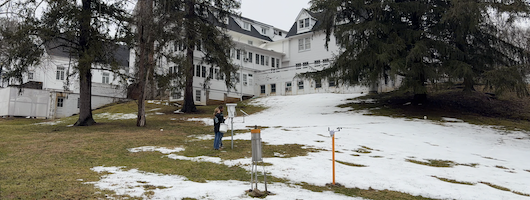
Bly Hartley (NCON) and Susan Foulk (Oldfields College Preparatory School) have coordinated efforts to establish a new NADP site in Maryland. We are pleased to announce that MD91 is now up and running. MD91 will operate as part of an Independent Study project, providing high school students the opportunity to participate in the NADP network. This initiative represents an outstanding opportunity for students at Oldfields College Preparatory School and is a valuable addition to the NADP community.
|
NADP Advisory Groups: These advisory groups advise the Executive Committee on quality management, quality assurance, and data management for networks and programs.
Quality Assurance Advisory Group (QAAG): QAAG advises the Executive Committee on matters of quality management and quality assurance for the NADP Program Office, networks, and laboratories. The QAAG also makes recommendations on the external QA programs and advises the Executive Committee on matters related to these programs.
Updates:Updated versions of NTN field protocols, including the new lid-weighing procedure, are now available on the NADP website. The final 2024 Quality Assurance Report (QAR) for the NAL and EEMS External Site Survey Program have also been posted.
|
Data Management Advisory Group (DMAG): The DMAG advises the Executive Committee on matters of data management for the NADP Program Office, networks, and laboratories.
Updates:The development work to scan NTN field forms using optical character recognition is nearing completion and we anticipate testing the updated workflow soon. NADP Program Office is creating data management plans for the PFAS NTN-subnetwork (PFN). We are updating internal software to support the updated airflow calculations for the new ALPHA samplers.
|
|




© 2026 National Atmospheric Deposition Program
465 Henry Mall, Madison, Wisconsin 53706
email: nadp@slh.wisc.edu
To unsubscribe from this group and stop receiving emails from it,
send an email to nadp-announce+unsubscribe@g-groups.wisc.edu.
|
|